Improve your Bulgarian split squat by checking setup and stability first, then building hip extension, ankle range and control with five targeted drills.
Own the position before adding mobility work
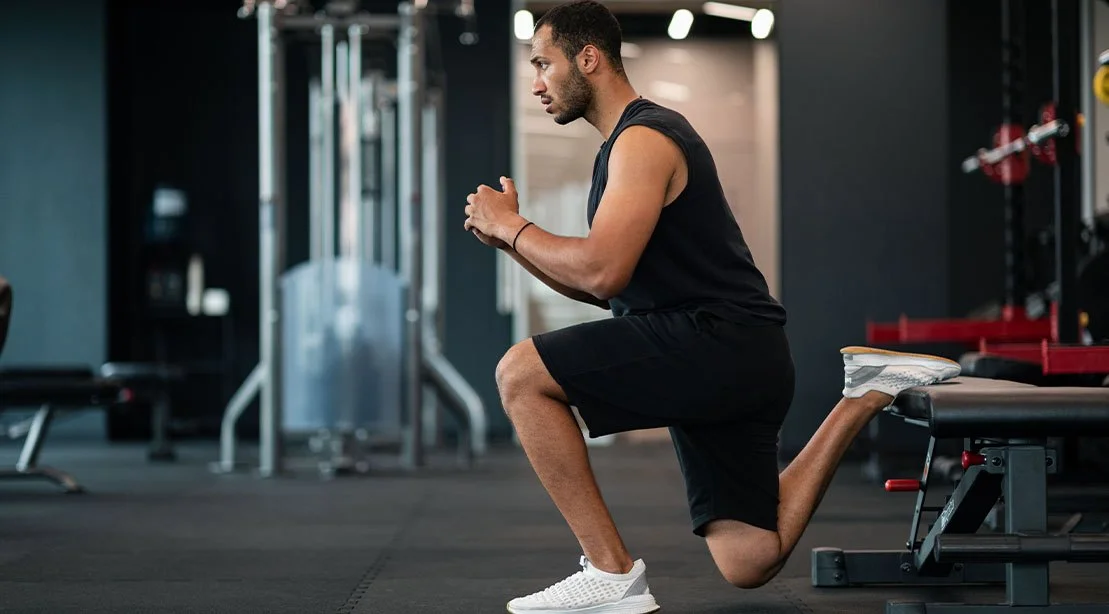
The Bulgarian split squat can expose a weak link that a two-legged squat lets you hide. It asks the front leg to control a deep bend while the rear hip extends, the front ankle moves forward, and the pelvis stays steady. When one part falls short, the result may be a shallow rep, a lifting heel, a wobble or an arched lower back. Those limits can get in the way of the exercise’s value for building quad and glute strength and size, and for addressing side-to-side strength differences.
That doesn’t mean every awkward rep calls for a stretch. A bench that’s too high, a stance that doesn’t suit your body, or a lack of balance can all make the movement feel restricted. Start by checking whether you can reach and hold the bottom position with control. Then adjust your setup before deciding that mobility is the problem.
Use the bottom position as a check
Put your rear foot on a weight bench and set your front foot where you can balance comfortably. Brace your trunk, keep the front foot planted, and lower as far as you can. Hold the position for five seconds, then push through the front foot to stand. Repeat on the other side.
Pay attention to how the two sides compare. One side may be harder to lower into or to push out of. A front heel that lifts can point to limited ankle dorsiflexion or a stance that needs adjusting. If your lower back arches as you descend, rear-hip extension or hip control may be limiting you. A front knee that caves inward can signal a need for more hip stability. Pulling or tightness across the rear thigh may reflect restricted hip flexors, while repeated wobbling can stem from balance, stability or setup.
The point is to find what changes the rep, not to chase a picture-perfect position. A brief hold gives you a useful clue about where control breaks down.
Adjust the setup before changing your program
A standard weight bench may be too tall for your current range. That extra height can make the rear hip work harder and may encourage you to arch your lower back or cut the rep short. Try a lower box or a few weight plates. Increase the height only when you can control the bottom position.
Foot placement matters, too. Standing too far from the bench increases the stretch on the rear hip. If your hip flexors can’t manage it, your back may arch and your balance may become less reliable. Bring the front foot closer until the descent feels controlled, without an excessive pull through the rear hip.
A stance that’s too short creates the opposite problem: you may feel jammed at the bottom, lose balance or push too much with the rear leg. Move the front foot forward a few inches, then test the descent again. Look for a position where the front hip and knee can bend and the front leg does most of the work.
And if you’re wobbling, don’t assume the issue is flexibility. Hold a squat rack or another stable support with one hand, then add a two- to three-second pause at the bottom. The support lets you practice the position; the pause gives you time to build control and strength there.
What the movement asks of your body
At the rear hip, you need enough extension to keep the pelvis and lower back from compensating as you descend. The rectus femoris, one of the quadriceps muscles, crosses both the hip and knee. Because the rear hip extends while the knee bends, a restriction there can create a strong pull through the front of the thigh.
The front hip needs to flex while the ankle allows the knee to travel forward over the foot. The adductors help stabilize the lower body and contribute to hip movement, so their range and control matter as well. Finally, the trunk, glutes and hip stabilizers must keep the pelvis from tipping or rotating excessively. Range gets you into position; strength and stability help you hold it and rise.
Five drills to build range and control
1. Lateral lunge to box
Although the split squat travels mostly up and down, your hips also need to manage side-to-side movement. This variation loads the adductors in a lengthened position and develops hip control that can help limit unwanted shifting.
- Stand sideways, about a step from a low box or stacked plates, with your knees slightly bent.
- Step onto the box and hinge into the working hip. Keep your chest up and the other leg straight.
- Sink into the working hip as far as you can, pause briefly, then push through that foot to return.
Use it unloaded for 10 repetitions per side as a warm-up, or perform two to four sets of 8–15 repetitions per side as an accessory for squats and deadlifts.
https://www.youtube.com/shorts/TML8Vqy-ACQ
2. Couch stretch
A restricted rear hip or quad can make a deep split squat feel like a tug across the front of the thigh. The couch stretch targets the hip flexors and quadriceps, including the rectus femoris, which crosses both the hip and knee. Keep the pelvis controlled so the stretch doesn’t turn into a lower-back arch.
- Place a folded mat or pad near a wall and kneel with your back toward it.
- Put one knee on the pad and that foot against the wall. If the position feels too intense, move the knee farther away.
- Bring the other foot forward into a half-kneeling stance.
- Squeeze the glute on the kneeling side, brace your abs and grow tall.
- Ease your torso upright until you feel a stretch. Hold, then switch sides.
Try two holds of 30–60 seconds per side during your warm-up.
3. Weighted ankle rocker
If your front heel comes up or your knee struggles to move forward, ankle dorsiflexion may be part of the problem. This half-kneeling drill practices that motion with the foot planted, helping you find a more controlled path into the bottom position.
- Kneel with your front knee above your ankle and your hips over the kneeling knee.
- Rest a light kettlebell or dumbbell on the front thigh, just above the knee.
- Keep the whole foot down and slowly move the knee forward over the toes.
- Use the weight to assist gently near your end range, pause, then rock back.
- Repeat for repetitions before changing sides.
Perform two sets of eight repetitions per side as part of your warm-up.
4. Front-foot elevated split squat with pause
More range is useful only if you can control it. Raising the front foot by two to four inches allows you to practice a deeper split squat; pausing there builds strength in the position and discourages bouncing out of the bottom.
- Place your front foot on a sturdy, low platform and find a comfortable split stance.
- Brace your abs and lower under control, letting the front knee travel over the toes.
- Go as deep as you can while keeping your front foot and hips steady.
- Hold the bottom for two to three seconds without relaxing, then drive through the front foot to stand.
Start with two sets of six repetitions per side, using a three-second pause at the bottom.
5. Half-kneeling hip flexor mobilization with overhead reach
The rear hip relies on more than the rectus femoris. The iliopsoas also affects hip extension, and limited range there can encourage the pelvis to tip forward or the lower back to arch. This drill pairs a hip-flexor stretch with active pelvic control; the reach and side bend increase the stretch without requiring you to twist.
- Get into a half-kneeling position with one knee on a pad.
- Squeeze the glute on the kneeling side and keep your ribs stacked over your hips.
- Reach the arm on the kneeling side overhead. Bend your torso away from that leg while keeping your hips facing forward and your lower back from arching.
- Pause briefly, return to the start and repeat before switching sides.
Perform two sets of eight reaches per side, holding the stretched position for three seconds each time.
Build a better rep, one constraint at a time
Use the drills that address what you found in the bottom-position check, and retest your split squat after changing one thing at a time. If a lower support or a small stance adjustment solves the issue, you may not need extra mobility work. If the same limitation remains, the relevant drill can help you practice the range you’re missing.
The goal is a controlled descent with pressure through the front foot and a stable pelvis. Mobility can make that position available, but strength and balance let you own it. That combination is what makes each repetition useful for building stronger legs.


Discussion
Sign in to join the discussion.