Research points to possible benefits for neck pain, diabetes and stress incontinence, while many mental health and cancer outcomes look similar to other exercise.
Yoga’s health value depends on what it’s being compared with. Studies suggest it may help with some physical conditions, including chronic neck pain and stress incontinence, but its benefits for mood, sleep and several cancer-related outcomes often look similar to those of other forms of exercise. That distinction matters: improvement over doing nothing doesn’t necessarily mean yoga has a special effect.
Yoga has been practiced for thousands of years and is now common in the United States. A 2016 survey estimated that 36 million Americans practiced it to some degree. That reach makes the evidence worth examining, especially because people may turn to yoga for quite different reasons, from flexibility to pain relief.
Why comparisons matter
Observational studies find that yoga practitioners tend to have better health status and lower rates of obesity. Those patterns can’t tell us whether yoga caused the difference. People who are healthier may be more likely to take up yoga, which is a form of reverse causation. The same problem applies when studies find more illness among practitioners: someone with pain or a chronic condition may start yoga in search of relief.
Randomized trials offer a clearer way to assess cause and effect. They can compare yoga with no intervention, usual care, or another activity. The choice of comparison changes what the result means. If yoga outperforms a group doing nothing, it may be useful; if it performs about as well as walking or another exercise, the benefit may come from physical activity more broadly.
That distinction shapes the findings on mental health. Reviews suggest yoga doesn’t improve depression compared with doing nothing. It may reduce anxiety, but the evidence doesn’t show a benefit for people whose anxiety meets the threshold for a diagnosed disorder. And when yoga is compared with other exercise, its apparent effect on anxiety disappears. The results therefore don’t support yoga as a distinct treatment for mood or anxiety disorders.
Among older adults, yoga appeared more helpful than other forms of exercise for depression. The same advantage wasn’t found for anxiety or perceived mental health overall. The evidence points to a narrower benefit than a general claim that yoga improves psychological well-being.
Where yoga may help with physical symptoms
Chronic nonspecific neck pain is one area where yoga appears to compare favorably with other approaches. A review of 10 randomized controlled trials found that yoga reduced neck pain compared with control groups, including groups assigned to other exercises. The authors concluded cautiously that yoga may ease pain, reduce pain-related disability, increase range of motion, improve quality of life and lift mood for people with neck pain.
Type 2 diabetes is another area with a positive signal. A review found that yoga groups had greater reductions in both short-term and longer-term blood sugar measures than exercise control groups. But the comparison wasn’t consistent enough to make the result definitive: nearly half the studies didn’t set and follow a well-defined exercise program for their control groups, and only three of the eight used an exercise intervention with intensity comparable to yoga. Six of the eight studies were conducted in India, a detail that also matters when considering how broadly the results apply.
For irritable bowel syndrome, evidence from randomized trials found yoga more effective than medication and about as effective as moderate-intensity walking. That makes yoga a possible option to consider, while the similarity to walking again suggests that movement may be part of the benefit.
Physical performance measures show a mixed picture. Yoga performed better than other exercise for lower-limb strength and lower-body flexibility. For balance, mobility and walking speed, it appeared to produce results comparable to other activities. The practical takeaway is that yoga can build some aspects of strength and flexibility, while the evidence doesn’t show a clear edge across every measure of physical function.
Bone health findings need caution
A study tested a 12-minute routine of 12 yoga poses intended to stimulate bone density in the spine and hips. The results suggested a benefit in the spine but not the hip. Yet the study began with 741 participants, and only a few dozen returned bone scans as requested—about 5% of those recruited. With so few results submitted, it’s difficult to know whether the findings represent the full group. People with positive results may have been more likely to send in their scans, so this study doesn’t provide convincing evidence that yoga improves bone strength.
Sleep, cancer recovery and urinary incontinence
For insomnia, yoga performed better than no intervention, but not better than controls that involved physical activity. Among cancer patients—most of them with breast cancer—walking was more effective than yoga for improving sleep. The pattern is similar for other outcomes in breast cancer survivors: six months of yoga had effects on systemic inflammation comparable to six months of non-yoga exercise, and yoga was no better than other physical activity for cancer-related fatigue or quality of life. The available evidence also doesn’t suggest that yoga relieves breast cancer-related lymphedema, a buildup of fluid for which effective treatment is lacking.
Urinary incontinence results differ by type. Urgency incontinence involves urine loss linked to a sudden, strong need to urinate; stress incontinence involves leakage triggered by actions such as sneezing. After three months, yoga didn’t significantly improve incontinence overall and didn’t produce a significant change in urgency incontinence. For stress incontinence, however, symptoms fell by an average of 61% in the yoga group, compared with 35% among controls. That result is promising, though the difference between the two types of incontinence means the finding shouldn’t be generalized to all patients.
More detail on these conditions is available in How to Prove Whether Yoga Has Special Benefits, Yoga Put to the Test for MS, Back Pain, Neck Pain, Insomnia, and Breast Cancer, Yoga Put to the Test for Headaches, Diabetes, Osteoarthritis, and Older Adults, Yoga Put to the Test for Depression, Anxiety, and Urinary Incontinence and Yoga Put to the Test for IBS, Inflammatory Bowel, Menopause, and Osteoporosis.
Injuries and sensible practice
Yoga’s risks appear broadly comparable to those of other activities, but they aren’t zero. A systematic review of nine observational studies included more than 9,000 yoga practitioners and 9,000 people who didn’t practice yoga, drawn from the United States, Europe, Asia and Australia. A considerable share of practitioners reported injuries or other adverse events, though most were mild and short-lived.
The review estimated 1.45 yoga-related injuries per 1,000 hours of practice. The reported rates were about 2.5 per 1,000 hours for running, 3.7 for soccer and 5 for tennis; skiing was more than five times as risky as yoga by this comparison. These estimates put yoga’s injury risk in context, but they don’t make every pose equally safe.

Headstands, shoulder stands, lotus and half-lotus poses, deep forward or backward bends, and handstands were identified as higher-risk movements. The spine was the most frequently injured area. Beginners should be especially careful with these poses and avoid pushing into positions they can’t control.
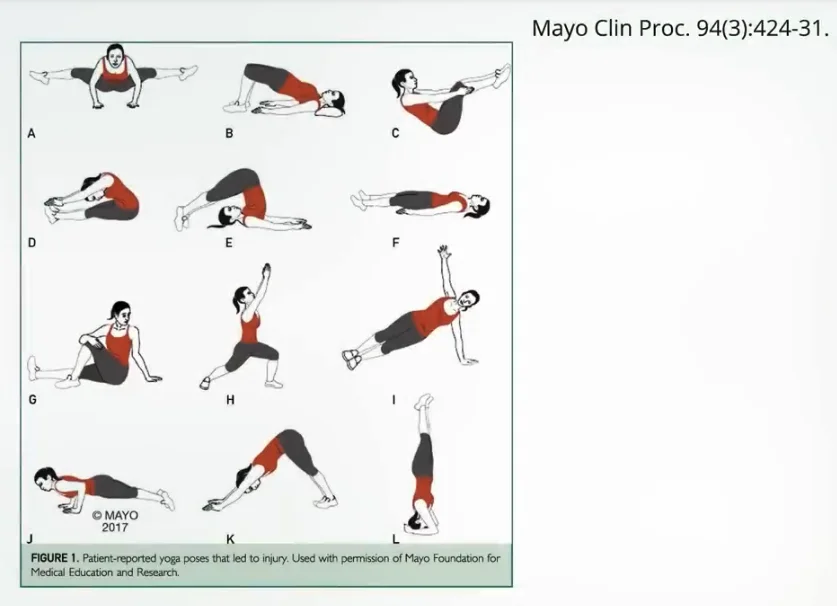
Yoga is best approached as physical activity that can be adapted to the person practicing it. A qualified instructor can help adjust postures, while people with medical conditions should discuss suitable modifications with their clinician and teacher. People with glaucoma should avoid inverted poses, and those with weakened bones should steer clear of forceful practices. Beginners should also avoid extreme poses such as headstands and lotus positions, along with forceful breathing.
The evidence suggests yoga can be a useful way to move, build flexibility and potentially ease certain symptoms. Its strongest case comes from specific outcomes, not broad promises: neck pain, some diabetes measures and stress incontinence show encouraging results, while many other findings are on par with ordinary exercise. For professionals assessing yoga’s role, the key question is what outcome matters and what activity provides the right comparison.



Discussion
Sign in to join the discussion.