Dana Linn Bailey’s three-stage lateral raise sequence combines band tension, dumbbell reps to failure and short pulses to fatigue the side delts.
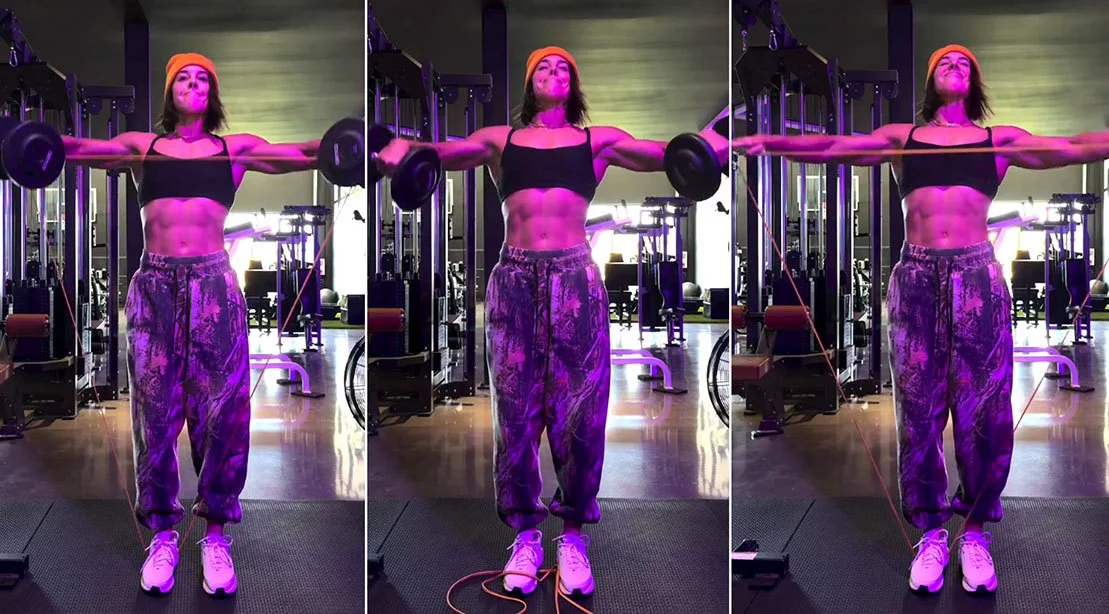
A lateral raise set designed to outlast fatigue
Dana Linn Bailey’s lateral raise sequence turns one shoulder exercise into three consecutive stages, extending the work after standard reps give out. The 2013 Olympia Women’s Physique champion shared the method in a recent Instagram post, presenting it as a way to keep tension on the side delts through fatigue. The premise is straightforward: when a lifter can no longer complete full-range dumbbell raises, changing the resistance and shortening the movement can keep the set going.
That structure makes the sequence more demanding than a conventional set, but it doesn’t require a complicated exercise rotation. Bailey stays with the lateral raise pattern, first combining dumbbells and a band, then using dumbbells alone, and finally switching to the band. The equipment changes as fatigue accumulates. So does the range of motion.
This is more significant than it looks. The method treats the end of a set as a point where the exercise can change, rather than an automatic cue to stop. That can make the final stage feel intense, though it also means the set can become difficult to control if the load or band tension is too high.
Bailey’s three-stage sequence
- Banded dumbbell lateral raises: 10 reps
- Dumbbell lateral raises: Continue to failure with the same weight
- Banded lateral raises: Perform quarter-rep pulses to failure
The sequence centers on the dumbbell lateral raise, which targets the lateral deltoid, the shoulder muscle that contributes to the appearance of width. Bailey adds resistance from a band, removes it for a failure set, then uses the band alone for short pulses. The changing setup lets her continue the set as her range of motion narrows.
In the first stage, the band and dumbbells make each repetition harder across the movement. After 10 reps, Bailey keeps the same dumbbell weight but removes the band. That second stage continues until she can’t complete another repetition. Only then does she put down the dumbbells and return to the band for quarter-rep pulses.
The order matters because each stage changes what the lifter can do. Full raises demand enough strength and coordination to lift and lower the arms through a larger range. Once that’s no longer possible, the band pulses use a smaller portion of the movement. A continued set, with less range.
Why the set keeps tension high
Bailey recommends choosing a dumbbell heavy enough for about 10 controlled reps in the first stage. That gives the set a clear starting point: the initial repetitions should be challenging, but still controlled. If the lifter has to swing the weights or shorten the movement immediately, the chosen load may not suit the purpose of the sequence.
The band adds resistance as the arms rise and on the lowering phase, so she cautions against letting it pull the arms down. That controlled return is part of the work. The point isn’t simply to get the weights back to the start position; it’s to manage the movement in both directions while fatigue builds.
For the second stage, remove the band but keep the dumbbell weight the same. Continue the raises until you can’t complete another rep. Then put the weights down, pick up the band and pulse through the top portion of the movement until those reps also reach failure.
Here’s the thing: “failure” in this sequence describes the point at which the lifter can no longer complete the intended movement. It isn’t a reason to let form collapse. The band-only pulses are already shorter than full raises, so keeping them deliberate helps distinguish the planned change in range from uncontrolled movement.
Bailey says the pulses can feel manageable at first, but the burn builds quickly. She suggests resting five to 10 seconds if needed, then continuing; she typically gets 20 to 30 pulses. The shorter range keeps the shoulders working near the peak contraction, where Bailey says she feels constant tension. And this is the part most people overlook: the brief pause is part of her stated approach, not a requirement to push through every repetition without stopping.
How to place the sequence in a shoulder session
She uses the lightest band for this approach and encourages lifters to continue through the burn. For anyone adding the sequence to a shoulder session, the practical takeaway is simple: keep the lowering controlled, then use the final pulses to extend the set after full-range reps end.
If you’re working in this space, treat the sequence as a demanding way to extend one exercise, not as a shortcut around sound execution. It combines multiple stages and takes each toward failure, so it may be more useful as a focused part of a workout than as a pattern to repeat indiscriminately. The source doesn’t prescribe how often to use it or how to combine it with other shoulder exercises; those choices depend on the wider session.
That said, the appeal is easy to understand. The method offers a simple progression within a single movement: begin with full raises against added resistance, continue with the dumbbells, then finish with band pulses. For lifters who tend to stop as soon as full repetitions become difficult, it provides a specific next step. The tradeoff is a longer, more fatiguing set, which calls for attention to control from the first rep through the last pulse.
What the method suggests
Bailey’s sequence is a practical example of extending a set by adjusting resistance and range of motion as fatigue accumulates. It doesn’t establish that this approach is superior to other ways of training the shoulders, and the post’s description doesn’t compare outcomes. Its value is more specific: it shows how one lifter organizes a challenging finish around the lateral raise.
What this means for you is that the set’s structure matters as much as its intensity. Pick a manageable band, use a dumbbell weight that allows controlled opening reps, and preserve the lowering phase before moving on. The final burn may be the memorable part, but the sequence depends on the earlier stages being performed with intention.
To follow Dana Linn Bailey on Instagram, click here.



Discussion
Sign in to join the discussion.