Stephanie Sanzo’s five-exercise routine uses hip thrusts, split squats and RDLs to load the glutes across a high-rep session.
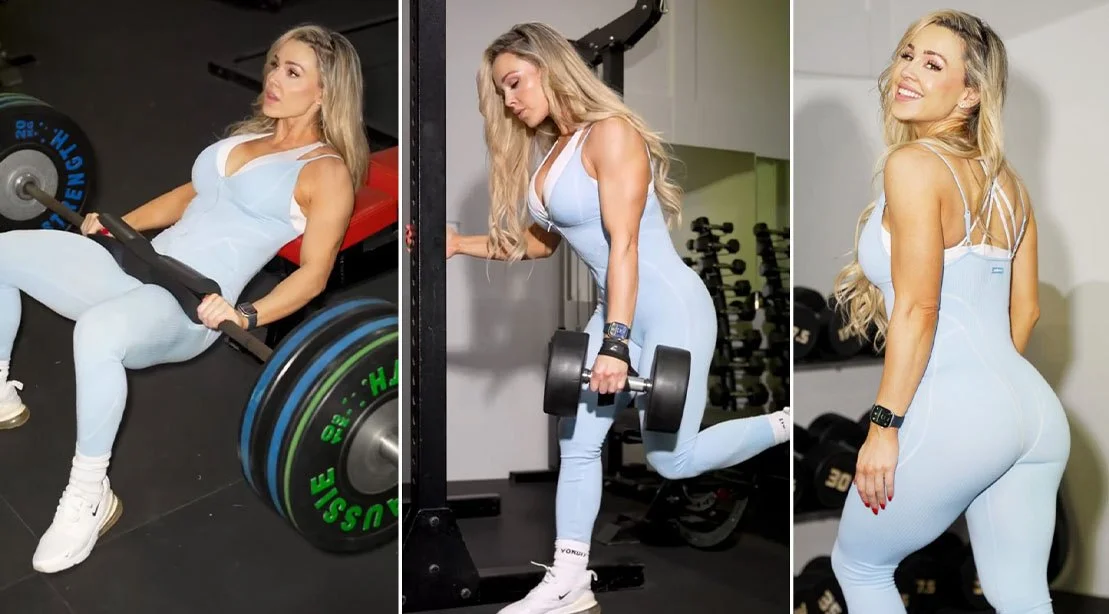
Stephanie Sanzo’s glute workout pairs heavy hip thrusts with single-leg work and a high-rep Romanian deadlift finish. The Australian weightlifter and personal trainer shared the routine with her 3.3 million Instagram followers, offering a straightforward template built around five exercises and three sets apiece. Its structure is easy to follow: load the hips while fresh, add a single-leg movement, then finish with smaller-targeted work and a hinge.
The sequence moves from hip thrust variations to unilateral strength work, then finishes with hip abduction and dumbbell RDLs. That progression gives the session a mix of loaded hip extension, balance-supported split squats and targeted outer-hip work. It also puts two hip thrust movements next to each other, a choice that concentrates effort on a similar pattern before the workout shifts gears.
Sanzo’s five-exercise routine
- Standing hip thrust machine: 3 sets of 20, 15 and 10 reps
- Barbell hip thrust: 3 sets of 10 reps
- Rack-supported dumbbell Bulgarian split squat: 3 sets of 12 reps
- Hip abduction machine: 3 sets of 15 reps
- Bench-supported single-leg dumbbell RDL: 3 sets of 20 reps
Read the rep scheme as a plan for one workout, not a universal prescription. The standing machine sets descend from 20 repetitions to 10, while the next hip thrust stays at 10 reps per set. That gives the routine a clear opening emphasis, but the post doesn’t specify how heavy the weights should be, how close each set should come to failure, or whether the final RDL count applies to each leg.
Those details matter when someone tries to reproduce a workout from a short social post. A rep target describes the work, but it doesn’t establish a suitable load for every lifter. If you’re working in this space, use the sequence as a template and match the resistance and range of motion to your own experience and control.
Why the exercise order matters
The opening standing hip thrust uses a descending rep pattern across three sets, totaling 45 repetitions. Sanzo’s workout then adds conventional barbell hip thrusts, keeping the focus on hip extension and glute loading. The source of the post describes short rests between exercises, making the full sequence a demanding volume session. That’s the part readers should weigh against their own capacity: short rests can make a session feel harder, even when the exercise list looks familiar.
Putting both hip thrust variations first gives the workout a strong emphasis on that movement pattern. The split squat then asks each leg to work independently, while the final RDL adds a hinge after the earlier hip extension work. Here's the thing: exercise order can shape what feels strongest and most controlled. If the first two movements leave you fatigued, the later exercises may require a lighter load or more deliberate pacing.
If your gym doesn’t have a standing hip thrust machine, Sanzo suggests standing cable pull-throughs as an alternative. For the barbell version, a bench supports the upper back; at the top of the lift, the body reaches a straight line from shoulders to knees. The substitution keeps a hip-driven movement in the opening slot, though the equipment and setup differ. That means the exercise may feel different even if it serves a broadly similar role in the session.
The rack-supported Bulgarian split squat brings in single-leg work. Using a rack or another stable support reduces the balance demand, so more attention can go to the working leg. Sanzo adds dumbbells to increase the load on the glutes and hamstrings. Support is a practical detail, not a shortcut: it can help a lifter focus on the movement rather than spending the set correcting a wobble.
Next, the hip abduction machine targets the outer hips. That movement trains muscles such as the gluteus medius, which contribute to pelvic stability and help control the legs during other lower-body exercises. The machine also changes the feel of the session after several compound lifts, narrowing the focus to moving the legs away from the body. A single machine exercise can’t stand in for all the demands of lower-body training, but it adds a distinct pattern to this lineup.
Sanzo closes with bench-supported, single-leg dumbbell Romanian deadlifts. The hip hinge shifts work to the glutes and hamstrings, while the bench provides support as each side works in turn. The listed 20 reps make this the routine’s highest-repetition movement, though the post doesn’t clarify whether that count is per side. Taken together, the routine is a compact example of how to combine bilateral lifts, unilateral training and direct hip abduction in one glute-focused session.
What the routine suggests about training
This is more significant than it looks: the workout isn’t just a list of glute exercises, but a sequence that moves between different demands. The first two movements share a focus on hip extension; the split squat adds a single-leg challenge, abduction isolates another action, and the RDL finishes with a hinge. That variety can make the session feel complete, but it also means the total work may be demanding, particularly if every set is performed with substantial load and short rest.
And yet, a social post can only show so much. It doesn’t tell readers how Sanzo warms up, chooses weights, adjusts the workout over time, or fits it into a broader program. Those omissions don’t make the routine unusable; they do make it a snapshot, rather than a full training plan. If you’re adapting it, the sensible question is how the exercises fit your current training and recovery, not whether you can copy every detail exactly.
For readers, the useful takeaway is the structure: a primary movement pattern, a supported single-leg lift, direct work for the outer hips, and a final hinge. The routine’s exact value will depend on how it’s performed and what surrounds it in a training week. A clear template. Not a complete prescription.
Follow Stephanie Sanzo on Instagram: visit her profile.


Discussion
Sign in to join the discussion.