Less Equipment, More Muscle With Anita Herbert...
The “FitQueen” showed how to get the most from each machine
Read articleAnita Herbert’s six-move Smith machine session combines presses, rows and pullups in three supersets, with rep targets for each exercise.
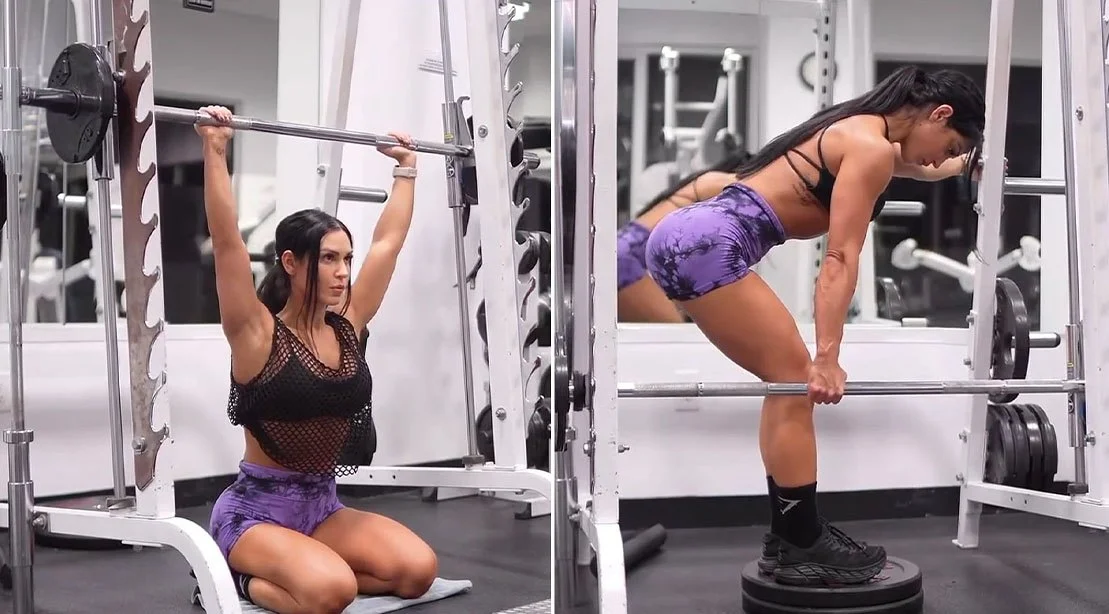
Anita Herbert’s Smith machine session pairs back and shoulder movements in three supersets, giving lifters a structured upper-body workout with set rep targets. The IFBB Pro and coach shared the routine on Instagram for her Fit Queen Army followers, highlighting the machine as one way to train without balancing a free barbell. That setup can make it easier to focus on the lift itself, especially for someone who’s still learning to control a press or row. But a guided bar path doesn’t remove the need to choose a suitable load and keep each repetition controlled.
The session includes presses, rows and pullups, with most exercises targeting the shoulders and upper back. Herbert also cautions that the Smith machine’s bar can feel heavier than a free weight because bar weights and counterbalance systems vary, while its fixed path changes how each movement feels. That warning matters because the number on a machine’s plates doesn’t always tell you how demanding a set will feel. A familiar exercise can change noticeably when the equipment changes.
The “FitQueen” showed how to get the most from each machine
Read articleHerbert’s routine alternates a pressing movement with a pull. Complete the listed rounds for each pair:
The pairings let you move between a push and a pull rather than repeating the same kind of effort back to back. The routine gives a different number of rounds for the middle superset, so follow the listed structure rather than assuming each pair gets the same volume. Rest periods aren’t specified in the routine; leave enough time to perform the next set with control, especially after the pullups.
The opening shoulder press emphasizes the front deltoids, with the upper back, triceps and core also involved. Herbert follows it with an underhand inverted row, which shifts the work to the mid-back, lats and rear deltoids. The sequence gives the upper body two distinct jobs: pressing the bar overhead, then pulling the body toward the bar. Keep the torso steady through both movements so the target muscles, rather than momentum, do most of the work.
Pair two combines a wide-grip pullup with a single-arm press. The pullup starts from a seated position, allowing the feet to help stabilize the body. A brief pause at the top increases time under tension; keeping the motion smooth and avoiding a shrug helps maintain the intended focus on the lats, rhomboids and upper trapezius. The one-arm press then trains the front deltoids and can expose differences in strength from side to side. Working one arm at a time also asks you to resist twisting as you press.
The final pair opens with a single-arm row that recruits the lats, traps and rear deltoids, along with the rotator cuff and forearms. Brace the core, keep the elbow close to the body and concentrate on driving through the back. Upright rows finish the session, working the shoulders and upper back while challenging grip strength. That’s a lot of upper-body work in one sequence, so the quality of the reps matters more than racing through the list.
Herbert says Smith machine resistance varies by model. “It can feel heavier than free weights, especially for upper body exercises because Smith machines have different bar weights, counterbalance systems and resistance,” she wrote in the comments. “The fixed bar path also changed how the movement feels, compared to free weights.” Check the machine’s setup before choosing a load; the listed reps provide a clear starting structure for the session. If you’re working in a gym with unfamiliar equipment, start conservatively and adjust after feeling how the bar moves. The machine’s apparent stability can make it tempting to load quickly, but the path and resistance still affect how a lift feels.
Here’s the thing: a fixed bar path changes the demands of a lift, even when the exercise name stays the same. It can reduce the balancing work involved in a free-bar movement, which may help a lifter focus on pressing or pulling. At the same time, the path may not feel natural for every person or every exercise. The machine doesn’t decide whether a rep is well controlled; the lifter still has to manage position, range and load.
This is more significant than it looks. Supersets can make a workout feel efficient, but the changing resistance and repeated transitions mean the prescribed rep targets are only a framework. Use them to organize the session, then pay attention to whether the final reps stay smooth. And this is the part most people overlook: a machine’s bar can have its own resistance before any plates are added.
Herbert’s routine offers a practical template for lifters who want to pair upper-body pushing and pulling on one machine. It also underlines why equipment familiarity matters: a Smith machine can make some movements feel more stable, but its bar weight and path aren’t uniform across models. The numbers here are underwhelming as a standalone measure of difficulty; the rep ranges don’t tell you what load to use or how challenging each set should feel.
What this means for you is straightforward: treat the list as a sequence, not a promise that the same setup will suit every gym. Use a load that lets you meet the target reps with control, and reassess if the machine feels different from the one you usually use. A good session depends on sound execution as much as on the exercise menu. Short version: know the machine before you push the pace.
Follow Anita Herbert on Instagram: Fit Queen Army.


Discussion
Sign in to join the discussion.