The 2024 Legion Pro winner shares a no-rest chest superset and hack squat dropsets designed to cap upper and lower body workouts.
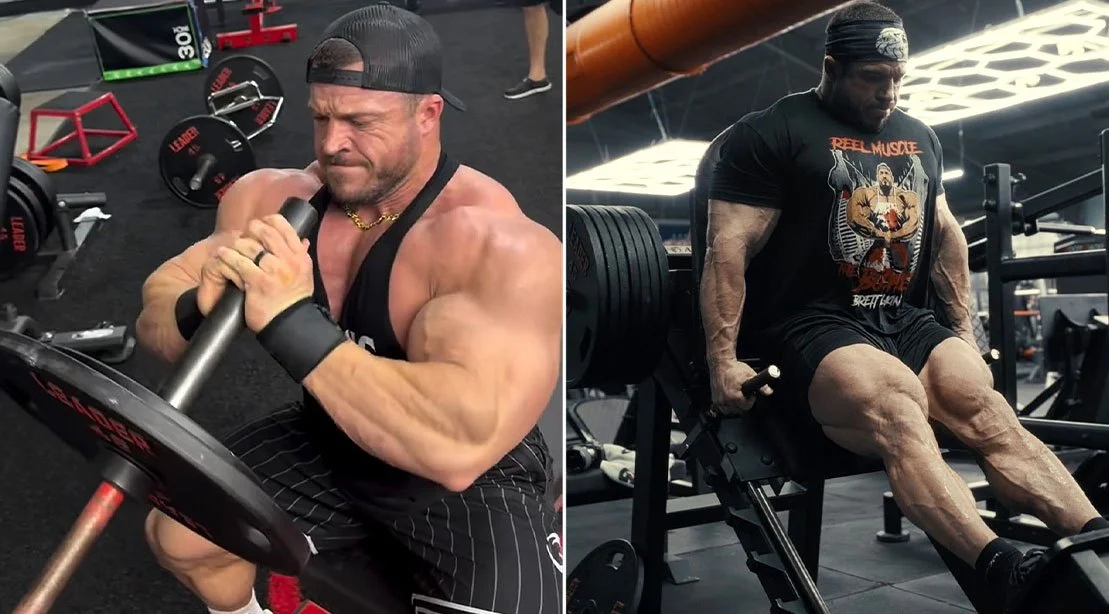
Brett Wilkin’s finishers show how a few hard sets can turn the end of a workout into focused work for chest and legs. The 2024 IFBB Legion Pro winner and 2025 Mr. Olympia finalist recently shared two approaches on Instagram: a chest superset taken to failure and hack squat dropsets for leg day. The methods are simple to describe, but they ask a lot of the muscles involved because both extend the work after fatigue has already begun to accumulate.
Both methods rely on pushing a demanding session toward failure, but the setup differs. Wilkin, who has more than 170,000 Instagram followers, pairs exercises for his upper body and uses short breaks to reduce the load during his lower body finisher. That distinction matters: one approach changes the exercise while keeping the sequence continuous; the other keeps the movement and lowers the resistance as the set progresses.
These are finishers, not a full training plan. Their appeal is the clear structure: pick a target muscle, keep the transition short, and sustain effort through fatigue. The tradeoff is equally clear. Hard sets can make the final part of a workout more demanding, but the clips alone don’t show how the work fits into Wilkin’s complete program, how often he uses it, or how another lifter should scale it.
Chest: cable flyes into landmine presses
Wilkin’s upper body sequence starts with standing cable flyes performed to failure, followed immediately by landmine presses. “Stretching it out big to start, then pumping out the inner and upper chest for complete balance,” he wrote, describing the combination as simple and effective. The sequence shifts from a movement that brings the arms together against cable resistance to a press that asks the chest, shoulders and arms to keep producing force.
The pairing moves from a wide, stretched position into a pressing pattern, with no rest between exercises. Cable flyes involve the chest and shoulders, while the two-handed landmine chest press adds more triceps involvement. Together, they let Wilkin keep working the upper body as fatigue builds. That continuous transition is the point: the second exercise begins after the chest has already worked hard, so performance may be limited by accumulated fatigue.
There’s a practical distinction between a hard set and a set taken to failure. Wilkin’s post describes the flyes going to failure, but it doesn’t provide a rep target or a load. If you’re working in this space, the useful takeaway is the structure, not a claim that everyone should copy the same effort level. The quality of the movement still has to hold as fatigue rises.
Legs: hack squat dropsets
For legs, Wilkin turns to the hack squat. He sets himself low in the machine to work his quads and hamstrings, then pushes toward failure. During brief pauses, plates come off before he starts another set, keeping the dropset moving with limited recovery. The changing load lets him continue the same exercise after the initial weight becomes too demanding for further repetitions.
Wilkin has joked that dropsets build character, adding that he rarely sees other gym-goers use them. He also pointed to tempo work as part of the effort. The combination of reduced weight, controlled reps and repeated hard sets makes this a demanding way to close out leg training. And yet, the clip doesn’t establish how many drops he completes or how much weight he removes, so those details shouldn’t be guessed at.
A dropset’s appeal is straightforward: it extends a set without requiring a long recovery break or a change of exercise. The cost is that fatigue can build quickly, and the later reps may feel very different from the first. (And this is the part most people overlook.) Reducing the load is only useful if the repetitions remain controlled enough to keep the intended movement intact.
What these finishers show
The two posts offer a compact look at how Wilkin adds intensity at the end of training. The chest sequence changes movements while keeping the effort continuous; the leg sequence changes the load while keeping the movement constant. Different mechanics, same aim: extend a focused bout of work as fatigue rises.
This is more significant than it looks as a training example, because it shows both the appeal and the limits of short social media clips. The movements are easy to identify, but the information needed to reproduce the session precisely—such as set count, load, and placement within the workout—isn’t included in the provided description. The clips can show an idea; they can’t, by themselves, tell you whether it belongs in your own routine.
Wilkin’s approach offers a clear template: use a no-rest pairing to extend chest work, then finish leg day with successive hack squat sets as the load falls. His posts give the sequence; the defining feature is taking each finisher close to the point where another rep won’t come. Briefly put: intensity with a clear endpoint.
Discussion
Sign in to join the discussion.