The American half-marathon record holder is adapting to higher mileage, better fueling and a race distance she plans to tackle one mile at a time.
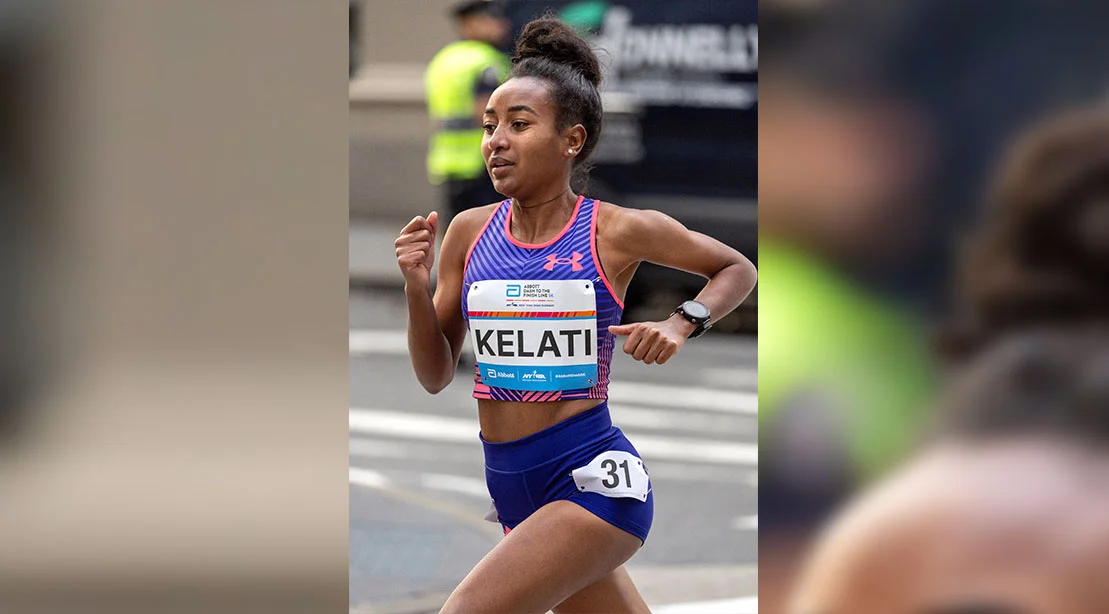
For Weini Kelati, marathon training has changed the meaning of a hard run. A distance that once felt like the end of a demanding day can now arrive halfway through a 20-mile workout. That shift is a useful measure of how she’s preparing for her first 26.2-mile race: by gradually making unfamiliar demands feel routine.
Kelati, the American half-marathon record holder, Olympian and five-time national champion, is set to make her marathon debut at the TCS New York City Marathon on Nov. 1. She’d long viewed the half marathon as a step toward the longer race, but didn’t rush the decision. She once set herself a loose benchmark of completing four or five half marathons before considering the marathon.
“I think first I was nervous,” Kelati said in an interview with Muscle & Fitness through New York Road Runners. “I was like, ‘Oh my goodness. This is going to be hard because I used to be at low mileage.’”
Her experience so far suggests the bigger challenge isn’t simply running farther. It’s building the capacity to handle more training, learning how to fuel and recover, and preparing to keep moving when a race reaches unfamiliar territory. Kelati’s approach has been incremental: let the body adjust, then raise the bar.
Making higher mileage feel familiar
In her half-marathon training, Kelati’s highest weekly mileage was about 75 miles. For the marathon build, she knew she’d need to reach into the 90s. The prospect initially made her uneasy. Once she began, though, she found herself enjoying the work.
The weekly structure hasn’t been radically different from what she knew. The change is in how far she extends familiar efforts. A tempo run of six or eight miles could be one of the longer sustained sessions in a 10K or half-marathon program. Marathon preparation adds longer runs, both easier efforts on the road and workouts that can reach about 20 miles at a specific pace.
“I’m not the type of person who rushes into something,” Kelati said. “I always take a lot baby steps to get used to something.”
That gradual build has helped her establish a new sense of normal. Instead of treating each added mile as a fresh test, she’s learning to see it as part of the work. During a 20-mile run, she can reach eight miles and recognize that she’s already well into the session.
“When you get to eight miles, you start saying, ‘Oh, I’m already halfway,’ instead of saying, ‘Oh, I used to stop here,’” Kelati said. “The mind and the body change the way I have to handle it.”
Fueling and recovery become part of the workout
More mileage has also exposed a weakness Kelati says she had to address: nutrition. At shorter distances, she could run in the morning without eating beforehand, even though that habit didn’t suit the demands of marathon training.
With a larger workload, fueling became part of preparing for the next hard session. Kelati says she didn’t need to force down a large meal when her appetite was low. Smaller meals spaced throughout the day offered another way to support her training.
“You have to help the body as much as it’s working,” she said. “During the marathon training, you have to fuel your body. You have to get ready for the next hard run.”
She’s also adjusted what she does after running. Meals had been her main recovery method, but the heavier training led her to add recovery drinks and pay closer attention to getting nutrition back into her body sooner. Her simplest recovery habit, though, is also the one she enjoys most: a nap.
“I love taking naps after every single run,” Kelati said. “It doesn’t matter how hard or easy the run I do, I just have to take a little nap every day and, of course, more than eight hours of sleep during the night.”
That rest helps her absorb the training and return ready to run again the next morning. The change in routine reflects a wider shift: preparing for a marathon means paying attention to the hours around the workout, as well as the miles themselves.
Keeping the race manageable
Training can prepare Kelati to run 20 miles, but it can’t fully answer how she’ll feel over the final 6.2 miles of her debut. She can talk with experienced marathoners and learn what they’ve encountered; she’ll still have to discover her own response on race day.
Thinking about all 26.2 miles at once doesn’t help. Kelati says that counting the full distance from the starting line can make the race feel daunting. Her plan is to focus on the mile she’s running.
“I just like to be in the present and focus one mile at a time,” she said.
She’s used a similar method to prepare mentally for new distances before. Ahead of her move to half marathons, she asked other runners which parts of the race tended to be hardest. This time, the guidance she’s hearing points to 30 kilometers, or roughly 18.6 miles, as the point when the race may begin to feel like a true contest.
“They keep saying, ‘You’re going to start racing when you get to 30K,’” she said. “It can be different, but also it’ll give you what to expect or what’s coming when you get to that distance and how you’re going to handle it.”
That advice gives her a marker, not a guarantee. Kelati knows discomfort will come, and she plans to remind herself that it’s temporary. She’d rather learn what she can do than finish with the feeling that she held back.
Confidence built in training
What Kelati says she’s proudest of is how naturally she adapted to the training her coach assigned. Each completed run has made the distance feel less abstract and reduced some of the uncertainty she felt when the marathon was only a future possibility.
“When you try to do something new, you always have these thoughts that can prevent you from doing something,” Kelati said. “But then once you just start doing it, I feel like we can do anything when we believe.”
When she reaches the start in Staten Island, she’ll bring the months of gradual preparation with her, along with memories of her early morning runs and past success racing in New York. Her stated goal is simple: feel good on the line and be ready to begin.
“I want to feel good just standing there and say, ‘Today is a great day,’” Kelati said. “‘I feel good. Let’s do this.’”
Follow Weini on Instagram @weini_kelati



Discussion
Sign in to join the discussion.